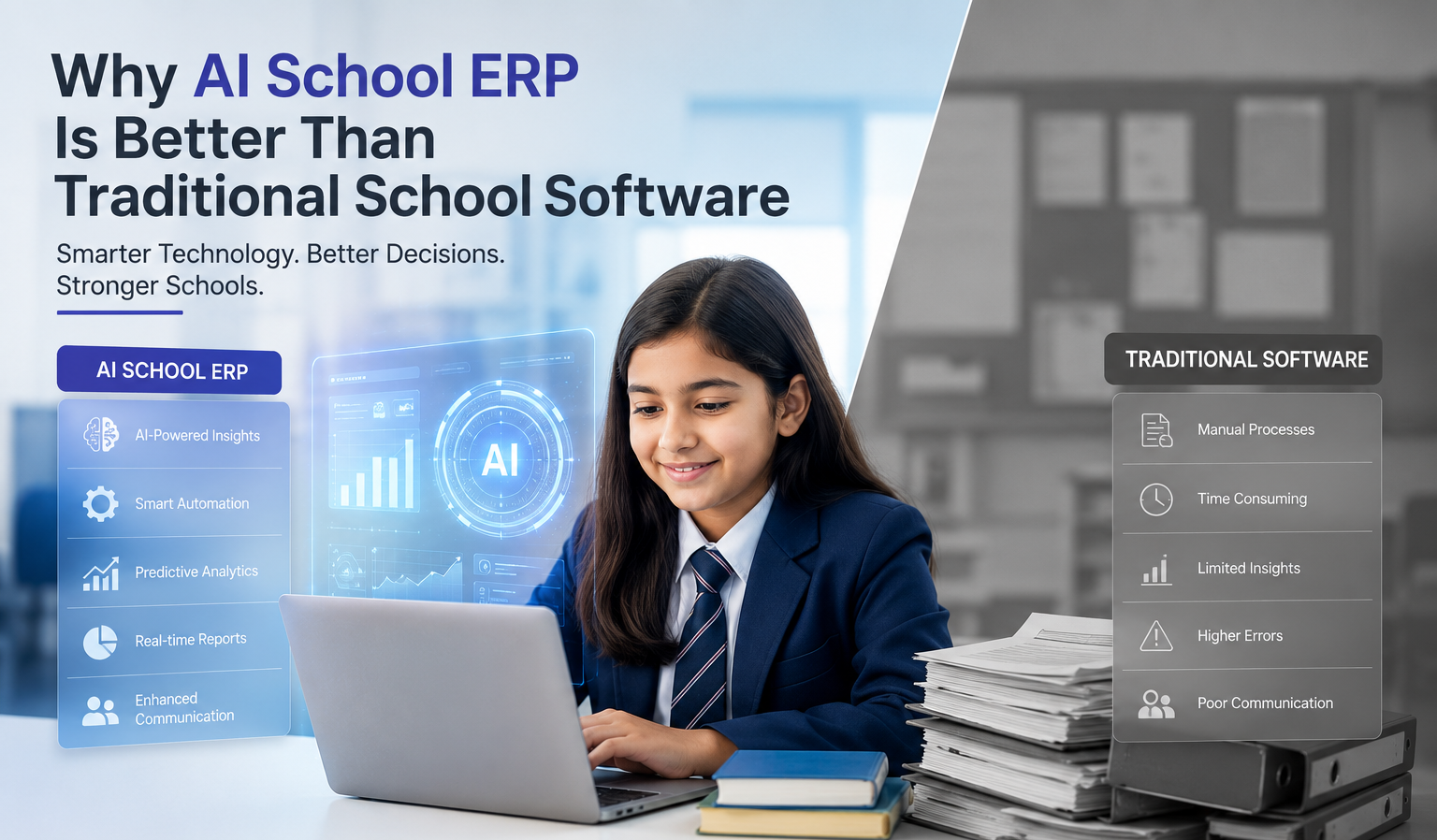
Schools today don’t struggle because of a lack of software. They struggle because most systems still work like digital registers. Data goes in, reports come out, but nothing really thinks in between. That’s where an AI school ERP system changes the game.
Instead of acting like a place to store records, the system looks at how information changes over time. That helps teachers and administrators spend less time on routine work and more time on school activities that need their attention. It feels less like software and more like a support system running quietly in the background. Traditional school software manages data.
On the other hand, an AI-based ERP school system manages decisions. That’s a big difference.
At Jupsoft, we focus on building AI-powered school ERP systems that simplify everyday school operations without adding complexity. Our goal is to help schools move from manual effort to intelligent automation that actually saves time and improves accuracy.
What Makes an AI School ERP System Different?
An AI-powered school system isn’t just a newer version of traditional school software. It works more like a system that quietly understands how a school runs and supports it in a more predictive way, rather than just recording data.
1. Automation that actually reduces workload
Attendance, timetable changes, fee reminders, report generation- these are the kinds of tasks schools deal with every single day. Most of them are repetitive, and honestly, they take more time than they should.
With an AI-based system, these tasks still happen automatically, but there’s an added layer. The system starts noticing patterns over time. For example, it may pick up on fee payment delays based on past behavior, or suggest timetable adjustments when the same conflicts keep happening. Even attendance issues don’t stay hidden until the end of the term—they start showing up early.
2. Smarter decision-making for schools
A traditional ERP mostly ends at reports. An AI school ERP system makes sense. Instead of forcing staff to go through charts and raw data, it quietly highlights what needs attention. Maybe it’s students who are slipping in performance, maybe it’s a class that needs extra support, or maybe it’s small operational delays building up over time.
The point is to reduce noise so decision-makers don’t get overwhelmed with information that doesn’t really matter. And that changes how day-to-day decisions are made inside schools.
3. Better communication between teachers, students, and parents
Most schools still rely on manual updates or multiple disconnected apps for communication. That usually leads to either too many messages or missed ones.
Schools send a lot of messages every day. Instead of everyone receiving every update, the system helps make sure each person gets only the information that is relevant to them.
So instead of a parent getting ten updates, they only see what actually matters at that moment. It feels less like broadcasting and more like structured communication.
4. Predictive insights instead of reactive reports
Traditional software tells you what already happened. That part is easy. The harder part is knowing what might happen next.
An AI-driven ERP system tries to bridge that gap. It can point out students who might be at risk of falling behind, notice attendance patterns that look unusual, or even highlight when resources might fall short before it actually becomes a problem.
Schools start preparing a bit earlier than they normally would. That small shift makes a big difference over a school year. For instance, a school with irregular fee collection patterns can get early alerts instead of waiting for monthly reports.
5. Simpler administration, fewer errors
Anyone who has worked in a school office knows how easy it is for small mistakes to happen. A student may be marked absent by accident, a fee entry could be missed, or the same information might get entered twice. These are everyday situations, especially when staff are handling large amounts of information. Having a system that helps keep records organized means less time spent finding and correcting those mistakes later.
It doesn’t replace people in the process, but it does remove a lot of repetitive correction work. And that frees up staff to focus on tasks that actually need human attention.
Why Choose Jupsoft?
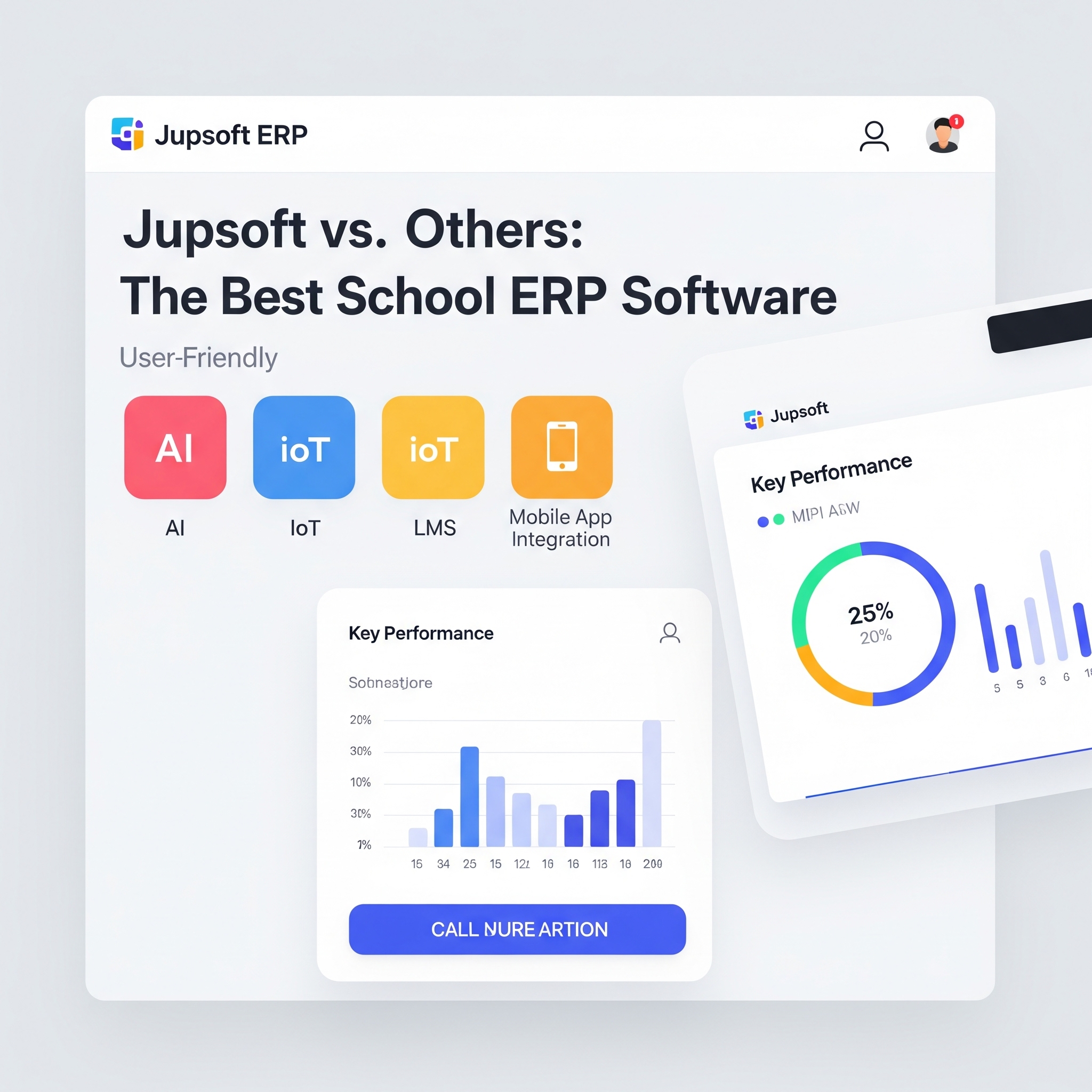
Modern schools don’t just need systems that digitize their processes; they need solutions that actually improve how those processes work in daily practice. That’s where the Jupsoft AI-Based School Management System comes in.
Jupsoft develops school management software with AI features for the way schools actually operate every day. The focus is on solving administrative and academic challenges. Some of the school problems that it solves are:
-
Simplify daily school operations
-
Integrating AI naturally into routine workflows
-
Supporting teachers, administrators, and management teams
Many platforms promote AI as a headline feature. Jupsoft takes a different approach by making it part of the workflow from the start. Schools don't need more dashboards to manage; they need information that is clear.
That difference becomes noticeable in everyday work:
-
Less time spent on repetitive tasks
-
Smooth communication across departments
-
Consistent data with fewer manual corrections
Instead of asking schools to replace the way they work, Jupsoft helps them improve the systems they already rely on, making everyday management more efficient and responsive.
Improve school efficiency with AI-based ERP software
School operations are getting more complex every year. More students, more data, more expectations. Traditional software can handle storage and tracking. But it struggles when decisions need speed or context. An AI school ERP system fills that gap.
It brings automation, prediction, and smarter workflows into one platform. Not in a complicated way, but in a way that actually fits into daily school life. Jupsoft’s approach shows how AI in education doesn’t have to be overwhelming. It just needs to be practical. And when it is, schools don’t just manage operations; they improve them.
FAQs
An AI-based school ERP system is school management software that uses artificial intelligence to automate tasks, analyze data, and support decision-making in schools.
Traditional software stores and processes data. AI-driven school ERP systems go further by predicting patterns, reducing manual work, and improving decision-making.
It usually includes automated attendance, smart reporting, predictive analytics, communication tools, and workflow optimization features.
No. Most modern systems are designed to be simple. The AI works in the background while teachers use a clean and easy interface.
Because they reduce administrative workload, improve accuracy, enhance communication, and help schools make faster and better decisions.